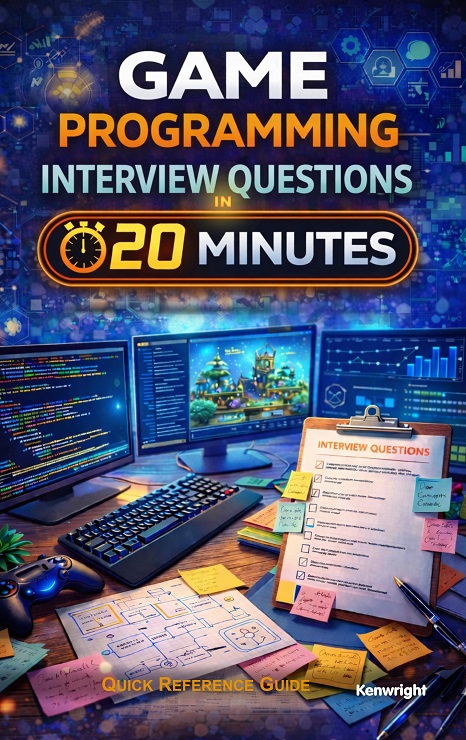
A thought-provoking exploration of Game Programming and its impact on the modern technology. This essential read offers fresh perspectives and practical insights that will transform your understanding.
This comprehensive work delves deep into the core concepts of Game Programming, offering readers a unique perspective that bridges theoretical knowledge with practical application. Readers will appreciate the author's ability to weave storytelling with scholarly insight, creating a rich tapestry of knowledge that is both informative and engaging. Whether you're seeking to deepen your understanding or simply explore new perspectives, "Game Programming Interview Questions in 20 Minutes (Coffee Break Series)" offers a rewarding experience that lingers long after the final page.
A must-read for anyone serious about mastering Physics Engines.
Couldn't agree more. The real-world examples made all the difference for me.
February 15, 2026
The interactive elements and prompts made it feel like a personal coaching session.
Same here. It’s rare to find a book that’s both intellectually rigorous and emotionally engaging.
February 25, 2026That insight on Game AI really stuck with me—so relevant to my work.
February 18, 2026
A must-read for anyone serious about mastering Physics Engines.
Same here. It’s rare to find a book that’s both intellectually rigorous and emotionally engaging.
February 24, 2026Stay updated with the latest from the book world
In his 1970s campus novel Changing Places, David Lodge introduced readers to a literary parlor game called Humiliation. The name of this game is also ...
Read More“Over the years, though, I noticed that some of those people would start thinking about politics only after something happened to them, or to someon...
Read MoreWhen Svetlana Satchkova set out to write The Undead, her novel about a young filmmaker targeted by the Russian state, she had to make negotiations bet...
Read MoreEnhance your reading and learning experience
Take brief notes after each chapter. Summarizing helps cement knowledge.
Use the Feynman Technique: teach what you learn to someone else to identify knowledge gaps.
Write documentation as if the next person reading it is a violent psychopath who knows where you live.
Organize books by color for visual appeal or by genre for practical access.
Follow the 20-20-20 rule: every 20 minutes, look at something 20 feet away for 20 seconds.
Use a pointer or your finger to guide your eyes. This can increase reading speed by 25%.
Sarah Johnson
Professional ReviewerSame here. It’s rare to find a book that’s both intellectually rigorous and emotionally engaging.
March 1, 2026